Earlier support, stronger futures for children and families
- 4 minutes ago
- 4 min read
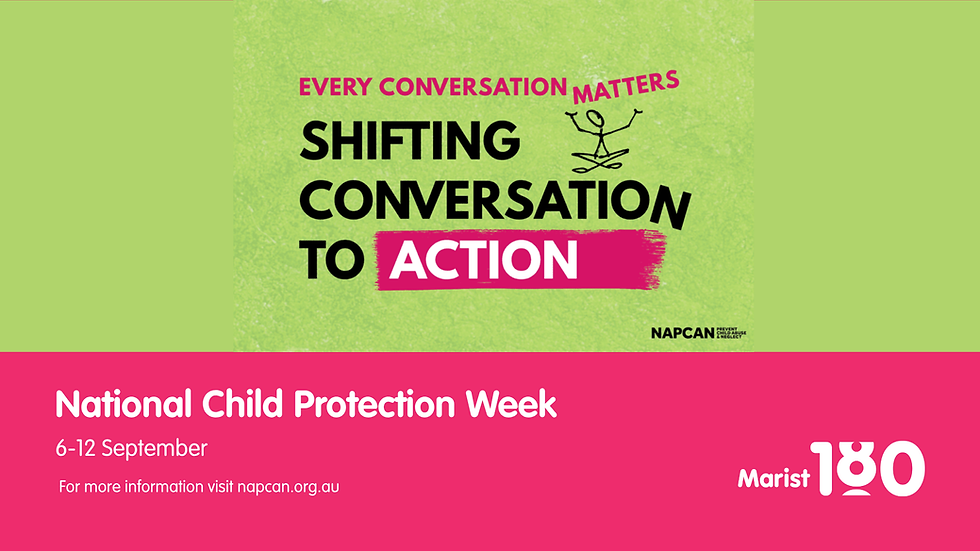
This National Child Protection Week, Marist180 is adding its voice to the call for action that helps children, young people and families get the support they need, when they need it.
National Child Protection Week, led by NAPCAN, runs from 6–12 September. This year’s theme, Every Conversation Matters: Shifting Conversation to Action, asks us to move beyond raising awareness and turn conversations about child safety and wellbeing into practical action.
For Marist180, one of those actions is advocating for stronger investment in supporting children, young people and families earlier.
The right support at the right time
Every child deserves the opportunity to grow up safe, supported and connected to family, culture and community. Creating those conditions means ensuring families can access support when they need it. When challenges can be addressed earlier, there is greater opportunity to strengthen families, support children to thrive and build wellbeing for the future.
As Marist180 CEO Angela Raguz explains:
“Every child deserves the opportunity to grow up safe, supported and connected to family, culture and community.
“Creating those conditions requires strong support for children, young people and families across our communities. When families can access the right support at the right time, challenges can be addressed earlier, helping children thrive and strengthening wellbeing for future generations.
“The evidence is increasingly clear. The question now is what it will take to translate that evidence into earlier investment that helps prevent harm before it occurs.”
It is a question that sits strongly alongside NAPCAN’s National Child Protection Week call to shift conversation into action.
NAPCAN CEO Leesa Waters says investing in prevention means investing in the conditions that help children and families thrive, including connected communities, practical support and opportunities for help earlier.
“It is how we reduce harm, strengthen families and build a safer future for every child.”
Listening to children and young people
Central to any conversation about better outcomes is listening to the people at its heart.
NSW Advocate for Children and Young People Katherine McKernan, who will deliver a special address at Marist180’s National Child Protection Week event, says meaningful change starts with taking the views of children and young people seriously.
“Meaningful change happens when we listen to children and young people, take their views seriously, and keep their needs at the centre of our decisions.”
For Marist180, this is fundamental to ensuring decisions about policy, investment and services remain focused on what children, young people and families actually need.
What does the evidence tell us? There is also a strong economic case for investing earlier. Economic modelling commissioned by Fams and undertaken by Lumenia found that investing earlier in children and families could return up to $2.97 in social and economic benefits for every $1 invested.
Fams CEO Susan Watson says:
“Early intervention and prevention are one of the most effective investments our government can make. When families get the right support early, children are safer, families stay together, and communities thrive.”
Lumenia Partner Mark Galvin puts the economic argument simply:
“Child protection is costly not because prevention is expensive, but because neglecting it is.”
The modelling provides an important foundation for a bigger conversation: if we understand the social and economic value of supporting families earlier, what needs to change for that evidence to translate into investment?
Earlier support must also be culturally safe
The discussion also needs to recognise the continued overrepresentation of Aboriginal and Torres Strait Islander children and families across child protection and out-of-home care systems. Fams is proposing a 30 per cent uplift in Community and Family Support services over four years, alongside transitioning 40 per cent of service delivery to Aboriginal Community Controlled Organisations.
AbSec CEO John Leha says shifting investment towards earlier support and Aboriginal community-controlled services is critical:
“Failure to shift funding to earlier supports and ACCO-led services perpetuates the overrepresentation of Aboriginal and Torres Strait Islander children and families at all stages of the child protection and OOHC systems.”
For Marist180, supporting culturally safe, Aboriginal-led and community-controlled responses forms part of a broader commitment to helping children remain safely connected to family, kin, culture and community wherever possible.
Bringing different voices to the table
On Friday 11 September, Marist180 will host A Smarter Investment: The Economics of Early Intervention, with the support of Commonwealth Bank. The National Child Protection Week luncheon will bring together leaders from government, community services, research, philanthropy and business around one central question: If we know early support changes lives, what will it take to make it the investment priority it should be?
Katherine McKernan will deliver a special address, while Susan Watson and Mark Galvin will present the economic modelling before joining John Leha and Associate Professor Tim Moore from Australian Catholic University for a panel discussion exploring what the evidence means for policy, investment and practice, and what needs to happen next.
Leesa Waters will also contribute, connecting the discussion to NAPCAN’s broader National Child Protection Week call to move from conversation into action.
From conversation to action
Marist180 is advocating for sustained investment across the child and family support continuum, with a stronger focus on prevention, earlier support and family preservation. That means making support easier for families to access when they need it; helping children remain safely connected to family, kin, culture and community wherever possible; listening to children, young people and families; and supporting culturally safe, Aboriginal-led and community-controlled responses.
The economic evidence matters. So too do the experiences of children, young people and families, and the knowledge of the services and communities supporting them.
National Child Protection Week gives us an opportunity to bring those perspectives together and ask what needs to happen next. Because the conversation matters. What we do with it matters even more.


